
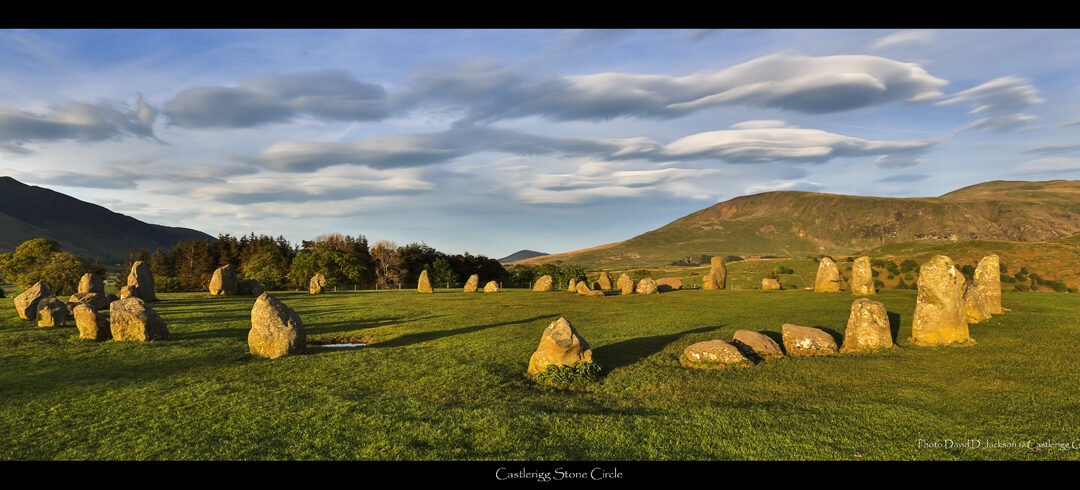
Uncover the Secrets of Castlerigg Stone Circle in the Lake District
Dramatically situated on a natural plateau above Keswick, Castlerigg Stone Circle is one of the Lake District’s most atmospheric ancient monuments. Surrounded by some of Cumbria’s best-known fells, its remarkable setting is almost as fascinating as the stones themselves.
The circle consists of 38 standing stones and dates from the late Neolithic period. Archaeologists believe it was probably created around 4,500 years ago, although its precise age remains uncertain.
Whatever its original purpose, standing among the stones and looking towards Skiddaw, Blencathra and the surrounding mountains gives you a wonderful sense of the people who gathered here thousands of years ago.
For guests staying at Castlerigg Hall, this extraordinary piece of prehistoric Britain is just over a mile away.
Originally published: 28 May 2024
Last updated: August 2026

The view to Blencathra from Castlerigg Stone Circle. Photo: David Jackson
How old is Castlerigg Stone Circle?
Castlerigg Stone Circle was probably constructed during the late Neolithic period, around 4,500 years ago.
Earlier archaeological theories suggested it could be more than 5,000 years old. However, because no modern archaeological excavation has taken place at the circle, its exact age remains something of a mystery.
The circle measures approximately 30 to 33 metres across. Today, 38 stones remain standing, although archaeologists believe the original monument may have contained 50 or more.
The stones vary considerably in size. Some are relatively small, while the largest may weigh around 16 tonnes. The builders probably sourced these huge rocks locally from boulders left across the landscape by retreating glaciers.
Just imagine moving one without modern machinery!

Looking South East from Castlerigg Stone Circle Lake District. Photo: David Jackson
Why was Castlerigg Stone Circle created?
Nobody knows for certain why prehistoric communities created Castlerigg Stone Circle, which is one reason the monument remains so fascinating.
It may have provided a ceremonial gathering place where communities came together at important times of the year. Seasonal gatherings could also have allowed people to exchange news, trade and strengthen relationships with neighbouring communities.
For many years, archaeologists also connected Castlerigg with the prehistoric stone axe industry in the nearby Langdale valleys.
Stone axes made from distinctive Lake District rock were traded across Britain and even further afield. An axe head discovered near Castlerigg in 1875 added to theories that the circle could have played a part in this trade. However, modern archaeological research suggests much of the axe production may pre-date the stone circle.
So, like many things at Castlerigg, the true story remains tantalisingly uncertain.

A fogbow sits within the circle of stones. Photo: David Jackson
Was Castlerigg Stone Circle used to observe the sun and stars?
Astronomers and archaeologists have long studied possible alignments between Britain’s stone circles and the movements of the sun and moon.
At Castlerigg, researchers have suggested a possible relationship with the midwinter sunrise. However, modern archaeology treats claims of precise astronomical alignments with some caution.
The surrounding landscape may also have looked very different when the circle was built. Woodland could have covered parts of the area, changing the views of the horizon that we enjoy today.
Nevertheless, the changing seasons clearly mattered greatly to prehistoric communities. Castlerigg may therefore have hosted ceremonies linked to midwinter and the gradual return of longer days.
Interestingly, Castlerigg continues to draw people together for celestial events today. During the recent solar eclipse, many people gathered at the Stone Circle to watch the spectacle unfold above the surrounding fells.
There is something rather special about that. Thousands of years after people first assembled at Castlerigg, we still find ourselves drawn to this ancient place to look towards the sky and mark unusual events in the heavens.
Of course, this doesn’t tell us why the Stone Circle was originally built. However, it adds another fascinating chapter to Castlerigg’s continuing relationship with people, landscape and sky.

Sunrise at the neolithic circle and shadows are cast. Photo: David Jackson
Was there once a second stone circle at Castlerigg?
One of Castlerigg’s greatest mysteries may lie not within the famous circle, but in the neighbouring fields.
When the antiquarian William Stukeley visited Castlerigg in 1725, he made what is regarded as the earliest known written description of the Stone Circle. He recorded around 40 stones and also described the unusual rectangular arrangement of stones within it.
Then, almost as an aside, he added a tantalising observation:
“There seemed to be another larger circle in the next pasture toward the town.”
Stukeley’s account was later published in Itinerarium Curiosum in 1776, eleven years after his death.
What did he see?
No trace of a second circle survives today and by the mid-19th century it had apparently disappeared. It is possible that Stukeley misinterpreted a natural arrangement of stones. However, another intriguing possibility is that a second prehistoric monument once stood close to the Castlerigg Stone Circle we know today and was subsequently dismantled.
Earlier antiquarians William Camden and John Aubrey both wrote about other Cumbrian stone circles, including Long Meg and Her Daughters, but neither is known to have visited or recorded Castlerigg. Stukeley’s description therefore provides our earliest tantalising glimpse of what this landscape may have looked like three centuries ago.
If his observation was correct, today’s famous circle may once have been part of a larger complex of prehistoric monuments spread across the Castlerigg plateau.
Nearly 300 years later, the truth remains hidden beneath the landscape.

An eerie mist envelopes the stones. Photo: David Jackson
What is the Sanctuary inside Castlerigg Stone Circle?
One of Castlerigg’s most intriguing features is a rectangular arrangement of ten stones within the main circle.
Early archaeologists named this feature the Sanctuary because they believed it might have been an ancient burial chamber or ceremonial structure.
More recent research has raised another fascinating possibility. The Sanctuary may be considerably younger than the stone circle and could represent the remains of a medieval shepherd’s shelter or sheep pen.
Interestingly, rectangular arrangements of stones are not entirely unknown within Cumbria’s prehistoric landscape. On Askham Fell, above Ullswater, a prehistoric ring cairn is accompanied by four small upright stones arranged in a rectangle. There is no evidence that this feature and Castlerigg’s Sanctuary served the same purpose, but the comparison is intriguing.
If smaller stones from the original Castlerigg circle were moved to construct the Sanctuary, that could also explain why archaeologists believe the circle once contained considerably more stones than we see today.
It is a lovely example of how our understanding of ancient sites continues to evolve.

Rain clouds over Castlerigg Fell.
What can you see from Castlerigg Stone Circle?
The setting is one of the things that makes Castlerigg Stone Circle so special.
The stones sit within a natural amphitheatre of mountains, creating wonderful views in almost every direction. From the circle and surrounding landscape, you can pick out famous Lake District fells including:
- Skiddaw
- Blencathra
- Helvellyn
- Walla Crag
- Grasmoor and the north-western fells
Few ancient monuments in Britain can boast such a dramatic backdrop.
It is easy to understand why generations of visitors, artists, photographers, poets and archaeologists have found Castlerigg so captivating.

Looking southeast to Clough Head, the Dodds and Helvellyn. Photo: David Jackson
When is the best time to visit Castlerigg Stone Circle?
Castlerigg changes character throughout the day and across the seasons, so there really isn’t a bad time to visit.
Early morning is one of our favourite times. The low light can illuminate the stones beautifully, while fewer visitors make it easier to appreciate the atmosphere of the circle.
Late afternoon and evening can be equally rewarding. As the sun moves towards the western fells, the changing light creates wonderful conditions for photography.
Autumn and winter bring a completely different character. Frost, mist and occasional snow can transform the stones and surrounding mountains.
The winter solstice is particularly associated with prehistoric monuments and attracts people interested in the possible relationship between Castlerigg and the midwinter sun.
If you enjoy photography, it is worth visiting more than once. No two visits are ever quite the same.
Photographing Castlerigg Stone Circle
“Having photographed Castlerigg Stone Circle for many years, one of the things I love about it is that it never looks quite the same twice. The position of the sun, cloud over the fells, mist, frost and snow can completely transform the atmosphere of the stones.
Early morning can produce beautiful light across the circle, while winter often brings some of the most dramatic conditions, particularly when snow lies on the surrounding fells.
A selection of my Castlerigg Stone Circle photographs is available at Castlerigg Gallery here at Castlerigg Hall, including framed prints and canvas images. So, if you fall in love with the view during your visit, you can even take a little piece of Castlerigg home with you.” David Jackson.

Winter in the Lakes and a snow covered stone circle. Photo: David Jackson
Walking to Castlerigg Stone Circle from Castlerigg Hall
One of the advantages of staying at Castlerigg Hall is that you don’t need to drive to the Stone Circle.
The monument lies just over a mile from our park, making it an enjoyable walk through the surrounding countryside.
Take a look at our walking route from Castlerigg Hall to Castlerigg Stone Circle for directions and ideas for extending your walk.
Walking also helps reduce pressure on the limited parking around the monument and gives you more time to enjoy this beautiful part of the Lake District.
If you walk to Castlerigg Stone Circle from Castlerigg Hall via Castle Lonning, look out for another intriguing feature as you arrive.
Close to the stile is a large outlying stone, standing apart from the main circle. It is easily overlooked when your attention is drawn towards the monument itself, but it adds another small mystery to the Castlerigg landscape.
Was it connected with the Stone Circle, did it mark an approach to the monument, or does it have an entirely different story? Like so much about Castlerigg, there are still more questions than answers.
Walking from the park also allows you to approach the circle gradually through the landscape rather than simply arriving by car — perhaps giving a little more sense of how people would have encountered this remarkable place in the past.

The two large stones marking the entrance to the circle, Blencathra beyond. Photo: David Jackson
Visiting Castlerigg Stone Circle
Castlerigg Stone Circle is cared for by English Heritage in partnership with the National Trust and is free to visit.
There is limited roadside parking nearby, so walking is a particularly good option whenever possible.
The ground around the stones is uneven and can become muddy and slippery after wet weather. Sheep also graze the field, so dogs should be kept on leads.
Most importantly, remember that this is an ancient and protected monument. Enjoy the stones, photograph them and experience their remarkable setting, but help preserve Castlerigg for future generations.

Looking west to Catbells from within the circle. Photo: David Jackson
Castlerigg Stone Circle for families
Castlerigg Stone Circle is a wonderful place to introduce children to the Lake District’s prehistoric past.
Rather than simply reading about the Stone Age in a book, children can stand inside a monument created thousands of years ago and imagine the people who once gathered there.
Try asking them some questions as you explore:
How did people move stones weighing several tonnes?
Why did they choose this particular location?
What ceremonies might have taken place here?
Why have the stones survived for thousands of years?
The fact that we don’t know all the answers is part of the fun.
Please remember that English Heritage asks visitors not to climb on the stones.
Discover more of Castlerigg’s history at Keswick Museum
To continue the story, visit Keswick Museum in Fitz Park.
Its collections explore the history, landscape and people of the Keswick area. Most significantly for the Castlerigg story, the museum holds the Neolithic stone axe head discovered close to the Stone Circle in 1875.
Made from distinctive stone quarried in the Great Langdale area, the axe provides a tangible connection with the prehistoric communities who lived and travelled through the Lake District thousands of years ago.

Sunrise over the ancient ring of stones. Photo: David Jackson
Stay near Castlerigg Stone Circle
For us, Castlerigg Stone Circle isn’t simply another Lake District attraction. It is part of the landscape surrounding Castlerigg Hall and somewhere we have visited throughout our lives.
Staying at Castlerigg Hall Caravan, Camping and Glamping Park puts you just over a mile from the stones. You can walk there early in the morning, visit as evening light falls across the fells or combine the circle with a longer day exploring the countryside around Keswick.
And when you return, the same mountains that surround this remarkable prehistoric monument form the backdrop to our park.
📅 Book Your Stay – Stay just over a mile from Castlerigg Stone Circle
🥾 Walk from the Park – Explore Castlerigg Stone Circle and the surrounding countryside on foot
🏕️ Camping & Touring – Pitches for tents, caravans, campervans and motorhomes
✨ Glamping – Enjoy a comfortable Lake District stay in one of our pods
🏡 Self-Catering – Holiday caravans in a beautiful setting above Keswick
🐾 Dog Friendly – Bring your four-legged friend along for your Lake District adventure
🌿 Naturally Sustainable – Explore the Lake District while helping us care for the landscape we all enjoy
Frequently asked questions about Castlerigg Stone Circle
Is Castlerigg Stone Circle free to visit?
Yes. There is no admission charge to visit Castlerigg Stone Circle.
How old is Castlerigg Stone Circle?
English Heritage currently dates the circle to around 4,500 years ago in the late Neolithic period, although its exact age remains uncertain.
How many stones are at Castlerigg Stone Circle?
There are 38 standing stones today. Archaeologists believe the original circle may have contained 50 or more.
Can you walk to Castlerigg Stone Circle from Keswick?
Yes. Castlerigg Stone Circle is within walking distance of Keswick. Guests staying at Castlerigg Hall can also walk directly from the park, which is just over a mile away.
Can dogs visit Castlerigg Stone Circle?
Yes, but dogs should be kept on leads because sheep graze the field.
Is there parking at Castlerigg Stone Circle?
There is limited parking close to the monument. Walking is a good alternative, particularly during busy periods.
What mountains can you see from Castlerigg Stone Circle?
The circle sits within a spectacular natural amphitheatre of Lake District fells. The surrounding panorama includes Skiddaw, Blencathra, Helvellyn, Bleaberry and the north-western fells.