

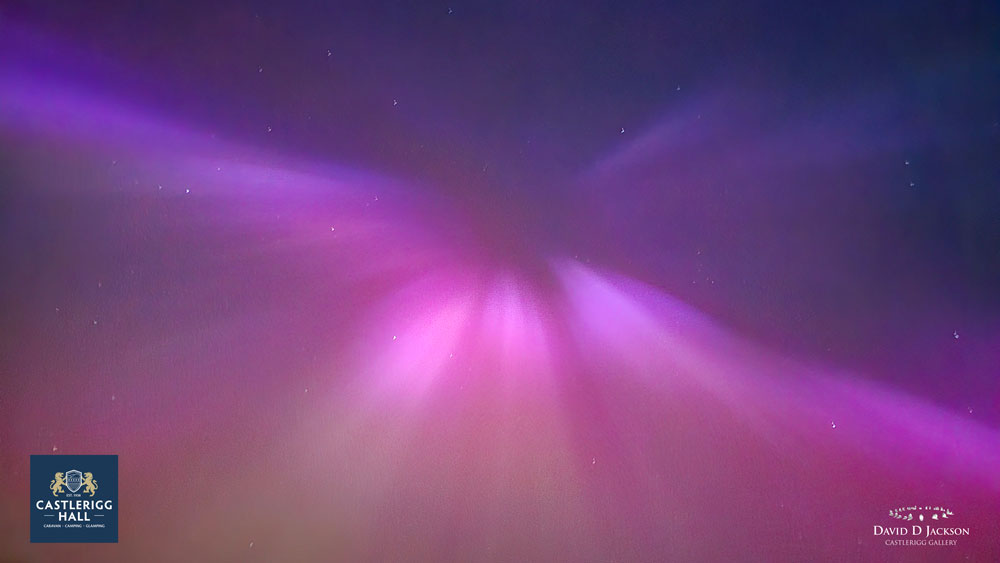
Looking directly up into the corona from Walla Crag. 10th May 2024
What Are the Northern Lights?
The Northern Lights, or aurora borealis, are one of nature’s most magical displays. This stunning phenomenon occurs when charged particles from the sun collide with gases like oxygen and nitrogen in Earth’s atmosphere, creating a dazzling light show with beautiful colours such as greens, reds, purples and blues that dance across the night sky.
While typically seen near the polar regions, strong solar activity can extend their visibility into the north of the UK and here in the Lake District.

The Northern Lights over Derwentwater on the 10th May 2024
Why 2024/2025 is Perfect for Northern Lights Viewing:
2024 and 2025, are particularly exciting for Northern Lights enthusiasts. The sun is reaching its peak activity in its 11-year solar cycle, known as the solar maximum. During this period, the sun has more sunspots and a stronger magnetic field, leading to an increase in solar flares and ejections. These solar events enhance the chances of witnessing the Northern Lights.
Recent solar storms have already provided stunning displays – (like the epic display on the 10th May 2024), and the forecast suggests more frequent and vivid auroras.

Colours of the Aurora over Keswick. 10th October 2024
The Carrington Event:
A historic example of solar activity’s impact on Earth was the Carrington Event, a massive solar storm that occurred in September 1859, just months before the solar maximum of 1860. In late August 1859, astronomers, including Richard Carrington, noticed an increase in sunspots. On 1 September, while sketching sunspots from his observatory near London, Carrington witnessed a sudden flash of light—a “white light flare”—which lasted about five minutes. This flare was a major coronal mass ejection (CME), which travelled the 90 million miles between the Sun and Earth in just 17.6 hours, an unprecedented speed for such events. When it reached Earth, it triggered stunning auroras seen as far south as the Caribbean, and caused widespread disruption to telegraph systems across the world. The Carrington Event remains the largest recorded solar storm in history, highlighting the powerful connection between solar activity and auroras.
Now is the perfect time to plan your trip and potentially witness the natural wonder of the Northern Lights. Book your stay at Castlerigg Hall Caravan, Camping, and Glamping (Castlerigg Hall) this autumn/winter and you might just catch this incredible sighting.
Best Spots for Catching the Northern Lights in the Lake District
The Lake District offers some of the best stargazing and northern light gazing spots in the UK, with minimal light pollution and stunning natural backdrops. Here are some top locations to consider:
1. Castlerigg Hall:
Nestled just outside Keswick, Castlerigg Hall provides an ideal stargazing environment with its clear skies and minimal light pollution. You can enjoy breathtaking views of the Milky Way and, with some luck, catch a glimpse of the Northern Lights right from your camping spot.
2. Surprise View, Derwentwater:
Surprise View is a particularly fantastic spot with unobstructed views over the lake, making it perfect for a peaceful evening under the Northern Lights. Be careful of the steep drops – particularly in the dark.
3. Grizedale Forest:
Amidst the ancient woodlands, Grizedale offers a dark sky for viewers to catch the aurora.
4. Derwentwater shore:
Head to the south end of Derwentwater near Ashness Jetty and look north across the Lake for the chance to see reflections of the Northern Lights dancing across Derwentwater.
5. Castlerigg Stone Circle:
This ancient site not only offers a glimpse into history but also serves as a fantastic stargazing spot. The stone circle provides a unique and mystical setting for an evening of celestial observations.
6. Great End, Seathwaite above Borrowdale:
If you’re an experienced hiker, and comfortable navigating at night, then a trip up Great End from Seathwaite can offer spectacular views across Borrowdale.

The Northern Lights from Castlerigg Stone Circle: 7th October 2015
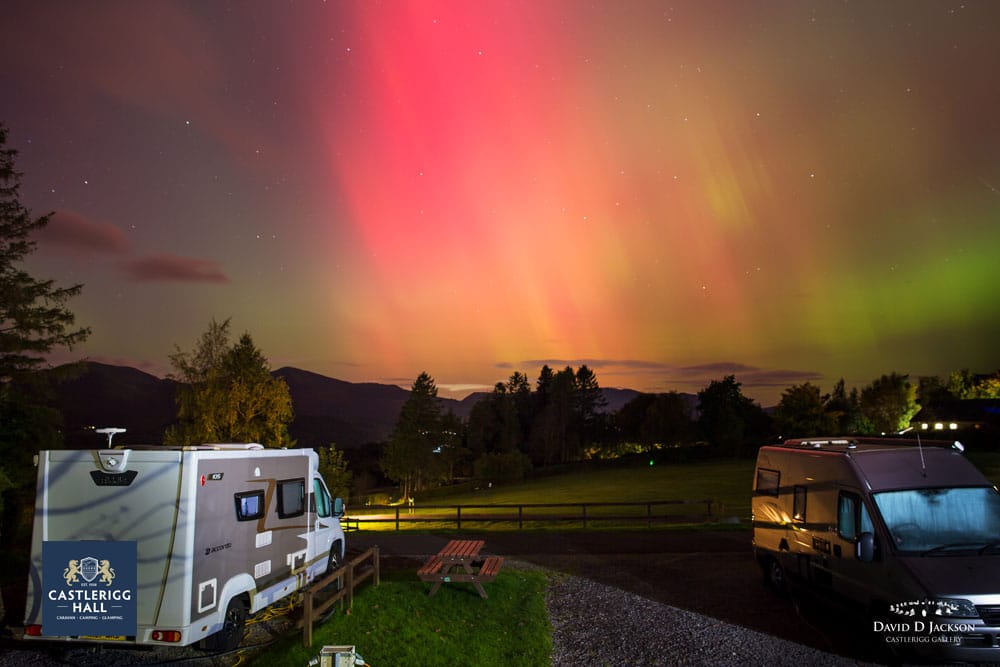
The Northern Lights from Castlerigg Hall Caravan Camping Glamping Park. 10/10/24.
Lord Derwentwater’s Lights:
The Lake District and particularly our region here next to Derwentwater has its own historical connection to the Northern Lights, known as “Lord Derwentwater’s Lights.” On 6th March 1716, just weeks after the execution of James Radcliffe, the third Earl of Derwentwater, for his role in the Jacobite uprising, a rare and vivid aurora borealis lit up the skies over England.
Witnesses described the phenomenon as “armies fighting in the sky” and “showers of blood.” This event, steeped in local lore, was seen as an ominous omen linked to the Earl’s tragic fate. Local lore suggests that his wife, Lady Derwentwater, fled from Lord’s Island via Lady’s Rake on Walla Crag after his capture.
According to family legend, she may have hidden in the secret room at Castlerigg Hall!

The Aurora Borealis above Bleaberry Fell: 10th May 2024
Tips for Enjoying the Night Sky
Stargazing can be a magical experience, especially in the Lake District. Here are some tips to enhance your night under the stars:
- Let Your Eyes Adjust: It takes about 20 minutes for your eyes to adjust to the dark, so be patient and allow your eyes to fully acclimate to the night sky.
- Use Red Lights: A red torch helps keep your night vision intact. You can easily make your own by painting a cheap light with red nail varnish.
- Keep Warm: Even in summer, it gets chilly at night. Dress in layers, bring a warm hat, and consider packing blankets or a bean bag to stay cosy while stargazing. Or experience glamping at its best in our Castlerigg Hall Hex Pods, each equipped with a skylight so you can stargaze from the comfort of indoors! Fall asleep under the twinkling night sky.
- Bring Binoculars: Binoculars can help you see more details in the night sky. They’re not as powerful as telescopes but will show 25 to 50 times more than the naked eye.
- Use Star Apps: There are plenty of apps that can help you identify stars and constellations based on your location and direction.
- Check Moon Phases: The moon can affect how well you see the stars. Try to stargaze when there’s no bright moon for the darkest skies and best views.
Photographing the Northern Lights
Capturing the Northern Lights can be simple and fun with the right equipment and techniques. Here are some tips to help you get started:
- Use the Right Camera: A DSLR camera that allows you to control settings like ISO and exposure time is ideal for photographing the aurora.
- Set Up Your Camera: Set your camera’s aperture to its largest setting and the ISO to at least 1600 to capture as much light as possible. This may require some experimenting.
- Focus to Infinity: Focus your camera on a distant light to ensure sharp stars, and make sure your auto-focus function is turned off.
- Use a Tripod: A tripod is essential for keeping your camera steady during long exposures. If it’s windy, consider using a heavier tripod for stability.
- Adjust Exposure Time: Exposure times between 10 and 30 seconds are typically best for capturing the Northern Lights. Longer exposures bring out colours, while shorter ones capture more detail.
- Avoid Shaking the Camera: Use a remote shutter or set the camera’s timer to prevent shaking when hitting the shutter button.
- Include Foreground Elements: Adding a dramatic foreground, like mountains or lakes, can enhance your aurora photos and create stunning images.

An astonishing display over the Helvellyn range. 10th May 2024
Day time Coffee Spots for Night Sky Enthusiasts:
Late-night Aurora chasing calls for the best coffee, and we’ve got you covered with some great spots around Castlerigg Hall:
- The Gallery at Castlerigg Hall: Our very own coffee and tea room, conveniently located on-site. Perfect for grabbing a warm drink before your stargazing adventure.
- Java Coffee Shop: Situated in the heart of Keswick, this cosy, bustling little café is ideal for a coffee break and makes a cracking hot chocolate
- Lingholm Kitchen and Walled Garden: A short drive from the site with on-site parking, perfect for tired legs after a nighttime adventure.
- Jasper’s Coffee House of Keswick: A popular spot for breakfast and a great place to start your day after a night of stargazing.
- Chinty’s Café: A quirky and welcoming spot, ideal for relaxing with a cup of coffee and reminiscing about the celestial wonders you’ve witnessed.
- Grange Cafe: At the south end of Derwentwater, an ideal stop off when on a scouting mission for locations around the lake.

Castlerigg Gallery serving tea, coffee and cake with Northern Lights photos for sale
Did You Know?
The Northern Lights are most active during the Equinox and Solstice in March/April and September/October, making these times ideal for planning your trip. Book your stay at Castlerigg Hall Caravan, Camping, and Glamping and make the most of this incredible opportunity to see the Northern Lights in the Lake District. With the perfect combination of stunning scenery and dark skies, your trip will be one to remember.