

Camping and Caravanning in 1990 at Castlerigg Hall
A Lake District holiday park on the cusp of change
Looking back at camping and caravanning in 1990 feels like opening a family album from a different world. At Castlerigg Hall, the views were the same as they are today – Derwentwater glinting below, Walla Crag rising behind us and the fells changing colour with every passing shower – but the way people holidayed was very different.
This was a time before online booking, before smartphones and before every camper arrived with a screen in their pocket. Guests booked their holidays by telephone or by post. A paper ledger acted as the booking diary. If someone wanted to ring home, there was one payphone in the house. If they wanted to know what was happening in the world, they bought a newspaper from the shop. And if they wanted a camping holiday in the Lake District, they still expected fresh air, good views and a warm welcome above all else.
At Castlerigg Hall, 1990 was a period of steady improvement and hard work. We were modernising the park, adding new facilities and trying to stay one step ahead of what holidaymakers wanted, while still keeping the relaxed, traditional feel that had made the site special for decades.
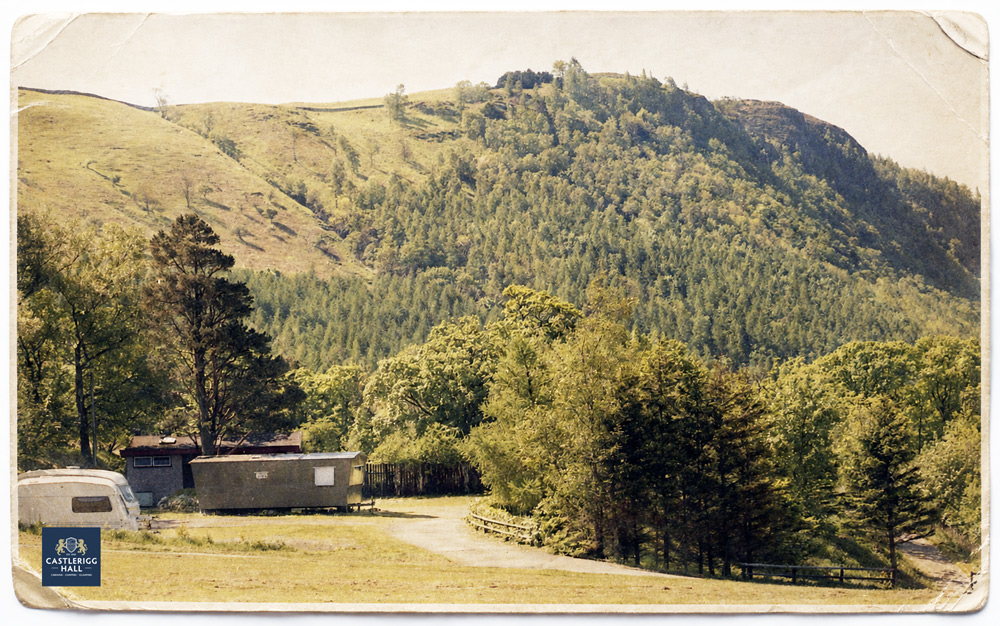
The view of Walla Crag and the middle terrace
What camping and caravanning in 1990 looked like at Castlerigg Hall
By 1990, Castlerigg Hall was already a well-established holiday park. However, it still retained much of the practical, hands-on character of its farming roots. Touring pitches were less formal than they are today. We cut the grass with a Bomford Bandit topper behind a Massey Ferguson 675. We also used a small Wheel Horse ride-on mower.
Jobs overlapped constantly. One part of the day might involve cleaning the toilet blocks. The next could find us digging drains or laying water pipes and electric cables. We often ended the evening with a final walk around the park to make sure everything was quiet for the night.
As David Jackson recalls:
“My old school friend Allan Carruthers came to work at Castlerigg, and together we were deeply involved in upgrading the site. Guest expectations were changing quickly, and we needed to keep pace. Every day involved juggling routine jobs with site maintenance and new developments. Cleaning, reception duties and shop work all had to fit into the day.
My mum, Betty Jackson, spent long days in reception and the shop. In 1986, my father and I converted the old cow byre into a new shop. By 1990, the shop had become an important part of everyday life at Castlerigg Hall.
My sister Chris and Jill also prepared takeaway food for guests. The menu included homemade quiche, jacket potatoes and a full salad. In 1990, you could buy the whole meal for just £2.00! It seems remarkably good value looking back today.
Two years after opening the shop, Allan and I built a new reception. For the first time, guests could come inside rather than stand outside at the old serving hatch.
The new reception became the information hub for the park. It held plenty of leaflets about local attractions and places to visit. As a result, we no longer needed the large outdoor noticeboard covered with posters. That was a relief for Mum. The timber had weathered so hard that pushing drawing pins into it had become almost impossible.
Around this time, Jill became increasingly involved in the business and took on the bookkeeping too. Reception and the shop opened every day from 8.00am until 9.00pm. They really were the heartbeat of Castlerigg Hall.”

The shop front late 1980’s, you can see the old redundant notice board to the left. Photo: David Jackson

Shop front, circa 1990. Takeaway, Homemade Quiche, Jacket Potato and full salad for £2.00!
From a 13-amp socket to a fully electrified touring park
One of the biggest changes around this period was the arrival of electric hook-ups for touring caravans and motorhomes. It marked a significant change in the way people camped. Until then, camping and caravanning had been a much simpler affair. By the early 1990s, however, guests increasingly expected electricity on their pitch.
David Jackson remembers:
“When guests first asked for electric hook-ups, we didn’t have any dedicated points. Instead, we offered them a pitch beside the maintenance shed. We passed their electric lead through the window and plugged it into one of the 13-amp sockets inside. It sounds rather improvised today, but it worked!
Before long, we realised that this wasn’t a long-term solution. We installed our first proper electric hook-ups on the Middle Terrace. To supply them, we buried a steel wire armoured (SWA) cable from the lower toilet block.
That first installation could supply only four hook-up points, each limited to 5 amps. The problem was the electricity supply to the toilet block itself, which came through an overhead cable. Its limited capacity meant we couldn’t simply keep adding more hook-ups.
It soon became obvious that guests wanted electricity wherever they pitched. Those first four connections were only the beginning. Before long, we knew that the entire touring park would eventually need to be electrified.”
The first hook-ups marked an important milestone for Castlerigg Hall. At the same time, we installed sewage connections to the static caravans. We also continued improving the water, drainage and electrical infrastructure around the park.
We also used the digger and roller when creating new touring pitches. The digger graded the stone sub-base before we compacted it with the single-drum roller. In fact, the roller probably spent more time preparing new pitches than it did working on the tarmac roads. Unfortunately, its old Lister engine could be rather reluctant to start.
David remembers:
“Starting the roller became something of a ritual. First, I primed the engine with diesel from an old Fairy Liquid bottle. Then came the hard part.
You swung the starting handle as fast as you could. You always kept your thumb alongside your forefinger rather than wrapped around the handle. That mattered if the engine decided to kick back.
At just the right moment, you pushed down the decompression lever. If you judged it correctly, the Lister engine suddenly burst into life with its familiar beat. If you got it wrong, you simply started all over again!”
These improvements came bit by bit rather than through one major redevelopment. Each new hook-up, drain, water pipe and stretch of tarmac moved the park forward. Castlerigg Hall was changing with its guests while retaining the character they had always valued.

The first ‘proper’ electric hook-ups at Castlerigg Hall. Photo: David Jackson
Touring caravans, campervans and tents in 1990
A walk around Castlerigg Hall in 1990 would have looked very different from the park today. There were still plenty of traditional tents, including ridge tents and larger family frame tents. Many took considerably more effort to put up than today’s lightweight designs. Family camping was still a hands-on affair. Windbreaks, awnings, folding tables and kettles on gas stoves were all part of the scene.
Touring caravans had a distinctive appearance too. Familiar British names included Swift, ABI, Elddis, Bailey, Lunar and Sprite. Cream or white bodywork was common, often finished with broad coloured stripes. Large front windows were another familiar feature.
Inside, caravans were generally more compact than today’s models. Patterned upholstery and wood-effect cabinetry were popular, while kitchens and washrooms made clever use of the available space. They were practical, cosy and designed very much with the family holiday in mind.
Motorhomes and campervans were less common than they are today. However, they were becoming an increasingly familiar sight at Castlerigg Hall. Coachbuilt motorhomes often used Fiat Ducato, Ford Transit, Talbot Express or Bedford chassis. Van conversions also continued to be popular.
Compared with today’s vehicles, onboard equipment was relatively simple. As the decade progressed, however, expectations began to change. More electrical equipment meant that access to an electric hook-up became increasingly desirable. That was a change we were already beginning to see at Castlerigg Hall.

Early synthetic tent in the campfield
The cars that brought people to the Lakes
The cars arriving at Castlerigg Hall were as much a part of the holiday scene as the caravans themselves. By 1990, Britain’s roads had a very recognisable look. Popular tow cars included Ford Sierras, Vauxhall Cavaliers, Austin Montegos and Volvo estates. Land Rovers, Toyota Corollas, Ford Granadas and Vauxhall Carltons were also familiar sights.
For many families, luggage space, reliability and towing ability were the priorities. Cars were often kept for much longer too. As a result, the campsite could resemble a rolling history of British motoring from the previous decade.
Once the car and caravan reached Castlerigg Hall, the next stop was reception.
David Jackson remembers:
“Checking guests in was very different from today. I usually sat on a stool behind the reception serving hatch. On sunny days, or when we were particularly busy, I often booked guests in at the window instead.
We still used the small receipt books that my parents had introduced years earlier. By the 1990s, the carbon copy sheet folded neatly between the pages. This was much tidier than the loose carbon paper we had used in the 1970s and 1980s. That deep blue paper had a habit of leaving its mark on your fingers.
We asked guests to complete their name and address in the book. We then worked out the cost of their stay using a printed pricing grid. It made the calculation much quicker. Finally, we handed them a small Castlerigg Hall windscreen sticker showing their departure date.
That little sticker had quite a history of its own. Dad introduced the system in the early 1980s, but the first version proved something of a disaster. You had to lick the front before sticking it to the inside of the windscreen. It certainly stayed put. Unfortunately, getting it off again was another matter!
You could sometimes recognise returning guests before they even reached reception. Remnants of an old Castlerigg Hall sticker would still be clinging stubbornly to the windscreen. Some guests simply gave up removing them and built up a collection from previous holidays.
Thankfully, by 1990 we had learned our lesson. We introduced a small, brightly coloured rectangular sticker and fixed it with double-sided tape. It was easy to attach and, more importantly, easy to remove. The system worked so well that we still use the same basic idea today.”

A typical early 1990s motorhome enjoying the open grass pitches at Castlerigg Hall. Electric hook-ups were only just beginning to arrive, and many visitors still preferred the simplicity of pitching wherever the view was best. Photo: David Jackson
Derwent Holiday Camp and organised group stays
Alongside the touring and camping at Castlerigg Hall, organised groups stayed in the Derwent Holiday Camp beside the park. Some slept in the dormitories, while others camped in tents. This added another dimension to life at Castlerigg during the busy summer months. It also continued a much older tradition of group holidays in the Lake District.
At full capacity, the Derwent Camp could accommodate around 180 guests. Youth groups, school parties and organised clubs brought tremendous energy to the site. There always seemed to be something happening. For many young people, it was their first visit to the Lake District. For some, it began a lifelong love of the fells.
David Jackson remembers:
“When the camp was full, life could become very busy indeed. With around 180 people in the dormitories and tents, the demand on our water and drainage systems was considerable. Running out of water wasn’t unusual on particularly busy days. Blocked drains also seemed to happen at the worst possible moment.
More than once, I had just sat down for my evening meal when someone arrived to report a blocked sewer. Dinner had to wait while I fetched the drain rods and dealt with it. By the time I returned to the table, my meal had usually gone cold. Somehow, it never seemed quite as appetising as it had before!”
The Derwent Holiday Camp belonged to an older tradition of youth groups, clubs and organised holidays in the Lakes. Long before modern touring caravans and motorhomes became commonplace, these camps introduced generations of young people to the Lake District.
We sometimes discovered just how important those early holidays had been many years later. Guests would tell us they had first visited Castlerigg as children and stayed at the Derwent Holiday Camp. Decades later, they were returning with families of their own. Some still remembered the dormitories, games, walks and excitement of those childhood holidays.
It was a lovely reminder that facilities may change, but the memories made here can last for generations.

The Campaigners Camp and their marching band. Photo: David Jackson
And what about the Lake District in 1990?
The Lake District in 1990 still felt wonderfully traditional in many ways. Keswick remained a bustling market town for walkers, campers and day-trippers. However, the digital age had yet to arrive. Guidebooks, printed maps and local knowledge still shaped most people’s holidays.
Alfred Wainwright was still alive in 1990, although he was in the final year of his life. He died in January 1991. By then, his famous Pictorial Guides to the Lakeland Fells had influenced generations of walkers. Many guests arriving at Castlerigg Hall would have carried a Wainwright guidebook in the car or caravan. It might well have decided where they walked the following day.
Keswick’s Century Theatre, affectionately remembered as the Blue Box, was another familiar landmark. Its distinctive blue structure stood close to Derwentwater. The theatre offered something quite different from a day on the fells and had an atmosphere all of its own.
David Jackson remembers:
“My then fiancée, Jill, took me to the Century Theatre around 1987 to see Educating Rita. I suspect it was her own subtle attempt at educating me! The Blue Box had a wonderful atmosphere, although I remember the roof leaked.
At the interval, we squeezed into the rather cramped bar for a drink. We then decided that a few more drinks in Keswick sounded preferable to watching the second half. So, I’m afraid I can’t tell you how the play ended!”
These were also the days before smartphones, online maps and instant information. Visitors relied on guidebooks, noticeboards and conversations with people who knew the area. In many ways, that slower pace was part of the Lake District holiday.

The mountain view remains the same. Photo: David Jackson
Why 1990 still matters in the story of Castlerigg Hall
Looking back now, 1990 feels like a bridge between two eras of camping and caravanning.
There were still handwritten bookings, payphones, paper maps and fewer gadgets. Even access to the park was simpler. We had no automatic barriers. Instead, two metal barriers created an evening chicane while making the entrance appear closed.
At the same time, the modern touring park was beginning to emerge. Electric hook-ups were arriving, facilities were improving and guest expectations were changing. We were laying cables, improving drainage and upgrading the park for the future.
Perhaps that is what makes these photographs from around 1990 so special. They capture much more than old cars, caravans, campervans and tents. They preserve a moment when holidays in the Lake District were changing.
Yet some things remain remarkably familiar. People still come to escape everyday life, spend time together and explore the fells. They come for the fresh air, the views and the simple pleasure of being somewhere special.
That is what these old photographs really capture. The views were timeless. The holidays were simpler. And Castlerigg Hall was steadily becoming the park that guests know today.
Article, David Jackson © 2026
Ready to Make Your Own Castlerigg Memories?
Camping and caravanning may have changed since 1990, but the reasons for escaping to the Lake District remain much the same. Come and enjoy our award-winning, family-run park above Keswick and Derwentwater – and perhaps start a few Castlerigg memories of your own.
📅 Book Your Stay – Book direct for your next Lake District escape
🏕️ Camping & Touring – Pitches for tents, caravans, campervans and motorhomes
✨ Glamping – Relax in one of our unique Hex Pods or Inspire Pods
🏡 Self-Catering – Comfortable holiday caravans in a beautiful Lake District setting
🐾 Dog Friendly – Bring your four-legged friend along for the adventure
🌿 Naturally Sustainable – An award-winning park with nature and sustainability at its heart
🥾 Walk from the Park – Step straight onto beautiful walks towards Walla Crag, Derwentwater and Keswick
📖 A Family Story – Welcoming generations of Lake District holidaymakers for more than 60 years
❤️ Make Your Own Memories – The caravans and facilities may have changed, but the views are as special as ever

What were two new caravans in 1990. Photo: David Jackson.
Frequently asked Questions about camping and caravanning in 1990
What was camping like in 1990 in the Lake District?
Camping in 1990 was generally simpler and less technology-driven than it is today. Many campsites still had informal grass pitches, fewer electric hook-ups and more basic facilities. Families often arrived with frame tents, touring caravans or early campervans and relied on paper maps, gas stoves and campsite shops for essentials.
Did campsites have electric hook-ups in 1990?
Some did, but many parks were only just beginning to install them more widely. At Castlerigg Hall, the early 1990s marked the arrival of the first electric hook-ups for touring caravans and motorhomes, reflecting changing guest expectations and a move towards more modern touring facilities.
How did people book camping holidays before the internet?
Most bookings were made by telephone or post. Campsites kept paper diaries or ledgers rather than digital reservation systems, and guests often planned their holidays using brochures, maps and local recommendations.
What types of caravans were common in 1990?
Popular British touring caravan brands around 1990 included Swift, ABI, Bailey, Sprite, Lunar and Elddis. These caravans were generally smaller and simpler than many modern models, with practical interiors designed for family holidays.
What cars were used to tow caravans in 1990?
Common tow cars included models such as the Ford Sierra, Vauxhall Cavalier, Austin Montego, Volvo estates, Land Rovers and older cars such as the Princess. Reliability, luggage space and towing ability mattered far more than style.
Was Alfred Wainwright still alive in 1990?
Yes. Alfred Wainwright was still alive in 1990, although he was in the final years of his life and died in 1991. His guidebooks were already legendary by then and remained a trusted companion for many walkers visiting Keswick and the wider Lake District.
Why are old campsite photographs important?
Historic campsite photographs show far more than changes in facilities. They reveal how people travelled, what they drove, how they camped, how parks were run and how family holidays in the Lake District evolved over time.